


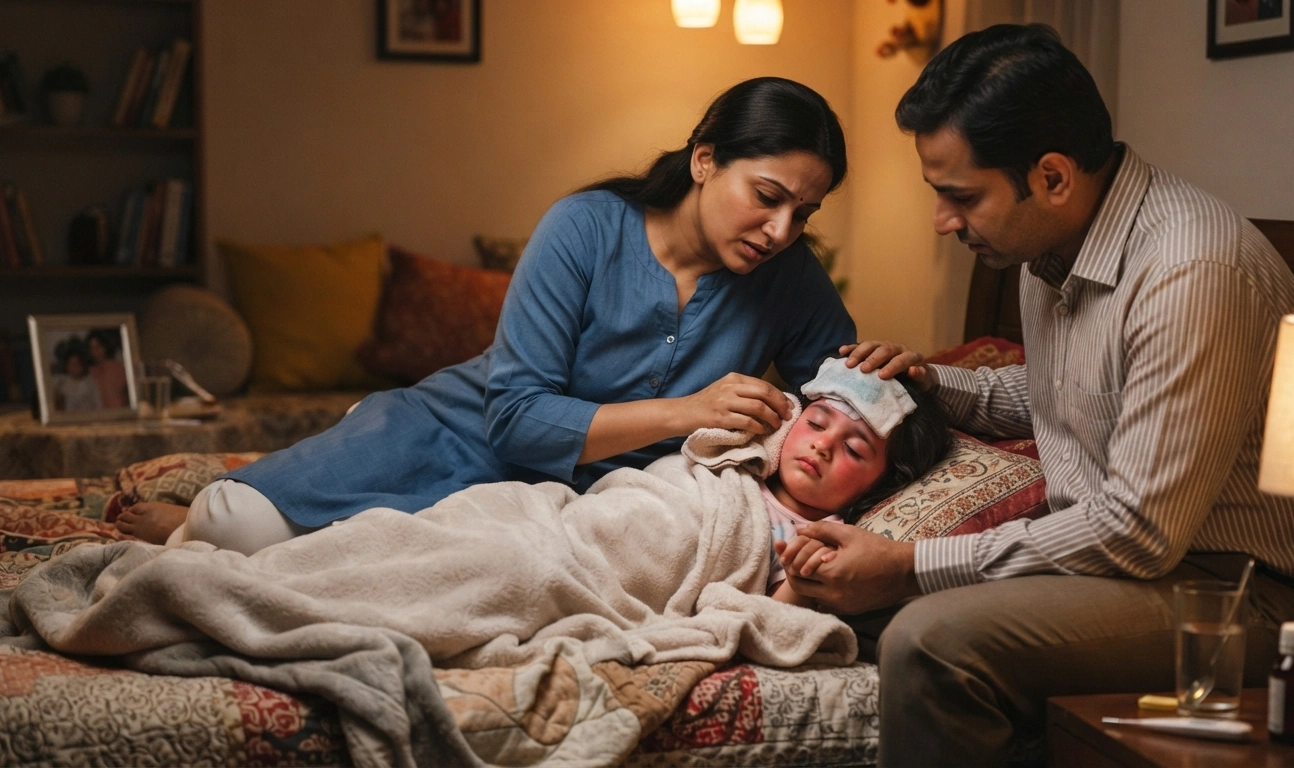
What Should I Do If My Child Has a High Fever?
Guidance from the pediatric team at Colours Hospitals, Nagpur
A temperature of 38°C (100.4°F) or higher is considered a fever in children. How concerning it is depends on the child’s age, how high the temperature is, the symptoms alongside it, and how the child is behaving overall – not the number on the thermometer alone.
Quick Answer
If your child has a high fever, check their temperature, offer frequent fluids, keep them comfortably dressed, and allow them to rest. Fever medicine may be used when appropriate for the child’s age and weight. More importantly, watch for warning signs such as difficulty breathing, unusual sleepiness, dehydration, seizure, stiff neck, persistent vomiting, or an unusual rash. Babies under 3 months with a temperature of 38°C (100.4°F) or higher need prompt medical evaluation.
Child Has High Fever? Do These 7 Things
1. Check the temperature correctly
Use a digital thermometer and follow the manufacturer’s instructions for the child’s age. Record the temperature and how it was measured, in case you need to contact a doctor.
2. Give frequent fluids
Offer water, ORS, coconut water, diluted juice, or breastmilk/formula in small, frequent amounts. Dehydration is one of the biggest risks with fever, especially in younger children.
3. Keep the child comfortably dressed
One light, breathable layer is enough. Avoid heavy clothing or blankets — overdressing traps heat and can push the temperature higher.
4. Let the child rest
Don’t force activity, school, or play. Rest supports recovery, and a cool, well-ventilated room (with a fan for air circulation, not pointed directly at the child) helps the body release heat naturally.
5. Use fever medicine only when appropriate
Paracetamol can be used when appropriate, according to the child’s weight and medical advice, if the child is uncomfortable. Don’t give aspirin to children unless specifically prescribed by a doctor. If dengue is suspected, avoid ibuprofen or other NSAIDs unless a doctor advises otherwise. Don’t alternate or combine medicines unless a pediatrician tells you to.
6. Watch hydration, not the clock
Watch for significantly reduced urination, fewer wet diapers, dry mouth, no tears when crying, or unusual sleepiness or weakness. A significant reduction in urine output can be a sign of dehydration and needs medical attention.
7. Watch for emergency warning signs
Keep an eye on breathing, alertness, and behavior throughout — this matters more than repeatedly checking the temperature. (Full list below.)
🚨 Seek Urgent Medical Care If Your Child
Some signs alongside a fever mean it’s time to stop watching and act. Head to the emergency room or call your hospital’s emergency line right away if your child:
- Is difficult to wake, or unusually unresponsive — doesn’t react normally to your voice or touch, or seems disoriented when awake
- Has difficulty breathing — fast, laboured, or noisy breathing, flaring nostrils, chest pulling in with each breath, or bluish lips or face
- Has a seizure — jerking movements, stiffening, or eyes rolling back, even briefly
- Has a stiff neck — resists neck movement, or cries more when the neck is touched or moved, especially alongside a headache or light sensitivity
- Develops a purple or non-blanching rash — small purple/red spots or bruising-like marks that don’t fade when you press a glass against them
- Shows signs of severe dehydration — no urination for a long stretch, sunken eyes, dry mouth, no tears when crying, or a sunken soft spot in infants
- Has persistent vomiting — unable to keep fluids down, which raises the risk of dehydration quickly
- Has severe abdominal pain — especially if it’s constant, worsening, or the child is doubled over
- Is under 3 months old with a temperature of 38°C (100.4°F) or higher — at this age, any fever needs same-day medical evaluation, even if the baby seems otherwise fine
If you notice any of these, don’t wait to see if the fever comes down first — get medical help immediately. Trust your instincts too: if something about your child’s condition feels wrong even without a textbook symptom, it’s worth getting checked.
What Not to Do
A few common instincts when trying to bring down a fever can actually do more harm than good, or mask a problem that needs medical attention:
- Don’t give a cold water or ice bath. It feels intuitive to cool the child down fast, but cold water causes shivering, and shivering generates heat — so the temperature can rise instead of falling. Stick to lukewarm sponging only, and only if the child is uncomfortable.
- Don’t wrap the child in wet cloth or extra blankets “to sweat it out.” Sweating doesn’t need to be forced, and trapping heat this way can push the fever higher and cause overheating, especially in infants.
- Don’t rub alcohol or spirit on the skin. It can be absorbed through the skin or inhaled, and has caused poisoning and breathing problems in children — it offers no real benefit over lukewarm sponging.
- Don’t give adult fever medicine, or adjust a child’s dose on your own. Adult formulations and doses aren’t calibrated for a child’s weight and can lead to accidental overdose.
- Don’t give aspirin to a child unless specifically prescribed. It’s linked to Reye’s syndrome, a rare but serious illness affecting the brain and liver.
- Don’t combine or alternate paracetamol and ibuprofen without a doctor’s guidance. This is a common but risky habit — dosing schedules can overlap in ways that are hard to track at home, increasing the chance of giving too much.
- Don’t wait out a fever if warning signs are present, hoping it will resolve on its own. Warning signs mean the fever needs medical evaluation, not more time.
Common Causes of High Fever in Children
Most fevers in children come from common, self-limiting infections — colds, viral fevers, throat or ear infections, and reactions to vaccination. Teething can cause a mild rise in temperature, but shouldn’t cause a true high fever on its own.
For parents in Nagpur, fever during monsoon may raise concerns about viral infections, dengue, or malaria, since these become more common between June and October. If your child’s fever persists beyond 2–3 days or is accompanied by warning signs, a pediatric evaluation can help identify the cause and guide the right tests and treatment.
Could a High Fever Be Dengue?
For parents in Nagpur, dengue can be a concern during and after the monsoon. Dengue can cause high fever along with symptoms such as headache, body aches, nausea, vomiting, or a rash.
Seek medical attention promptly if the fever is accompanied by severe abdominal pain, persistent vomiting, bleeding, extreme weakness, unusual restlessness, or breathing difficulty.
If dengue is suspected, do not give ibuprofen, aspirin, or other NSAIDs unless advised by a doctor.
When to Seek Medical Advice, by Age
| Child’s Age | When to Seek Medical Advice |
| Under 3 months | Any temperature of 38°C (100.4°F) or higher needs prompt medical evaluation |
| 3–6 months | Seek medical advice if the child has a high fever, seems unusually sleepy, feeds poorly, or appears unwell |
| 6 months and older | Seek medical advice if fever persists, the child is becoming more unwell, or concerning symptoms develop |
| Any age | Seek urgent care for breathing difficulty, seizure, stiff neck, severe dehydration, unusual rash, unresponsiveness, or severe pain |
What About Febrile Seizures?
Some children between 6 months and 5 years can have a brief seizure triggered by a rapid rise in temperature, called a febrile seizure. It’s frightening to watch, but most last only a couple of minutes and don’t cause lasting harm.
- If a seizure lasts under 5 minutes, keep your child safe on their side and contact your doctor once it stops.
- If it lasts 5 minutes or longer, or your child doesn’t recover normally afterward, treat it as an emergency and seek immediate medical care.
How Colours Hospitals Can Help
Colours Hospitals, Ajni Square, runs a dedicated Pediatric OPD, Pediatric Intensive Care Unit (PICU), and Neonatal Intensive Care Unit (NICU), with 24/7 emergency care and an experienced team of pediatric consultants. Whether it’s a routine fever that needs reassurance or one with warning signs that needs urgent evaluation, our doctors are available round the clock.
In case of a high or persistent fever in your child, don’t wait it out — call our 24/7 emergency line at +91-8956829111 or book a consultation.
Frequently Asked Questions
1. What temperature counts as a fever in a child?
A temperature of 38°C (100.4°F) or higher is considered a fever. How concerning it is depends on the child’s age, symptoms, and overall condition, not the reading alone.
2. What should I do if my child’s fever is 103°F?
Focus on comfort and hydration – offer fluids, dress them lightly, and let them rest. Fever medicine can be used if they’re uncomfortable, at the correct dose for their weight. Watch closely for warning signs rather than fixating on bringing the number down to normal.
3. When should a child with fever see a pediatrician?
See a pediatrician if the fever lasts more than 2–3 days, keeps returning after settling, is accompanied by any of the emergency warning signs, or if your baby is under 3 months old with any fever at all.
4. How long does a viral fever usually last in children?
Most viral fevers settle within 3 to 5 days. If it continues longer, or returns after settling, it should be evaluated to rule out a bacterial infection or a monsoon-related illness like dengue or typhoid.
5. When should I take my child to the hospital for fever?
Go in promptly if your baby is under 3 months old with any fever, or if the fever comes with any of the emergency warning signs — difficulty breathing, a seizure, stiff neck, unusual rash, persistent vomiting, or unresponsiveness.
6. Can high fever cause seizures in children?
Yes, some children aged 6 months to 5 years can have a febrile seizure when temperature rises quickly. Most are brief and not harmful, but any seizure should be reported to a doctor, and one lasting 5 minutes or more is an emergency.
7. How can I bring down my child’s fever at home?
Offer fluids frequently, dress them lightly, keep the room cool, use lukewarm sponging if needed, and give fever medicine only if appropriate for their weight and age. Medicine usually takes 1–2 hours to work and won’t necessarily bring the temperature fully to normal – that’s expected.
8. Can my child go to school with a mild fever?
It’s best to keep them home until their temperature has stayed normal, without medicine, for at least 24 hours, to avoid spreading infection to others.
9. Can I give ibuprofen to my child if dengue is suspected?
If dengue is suspected, do not give ibuprofen, aspirin or other NSAIDs unless specifically advised by a doctor, because they may increase bleeding risk. Consult a pediatrician for appropriate fever management.
